
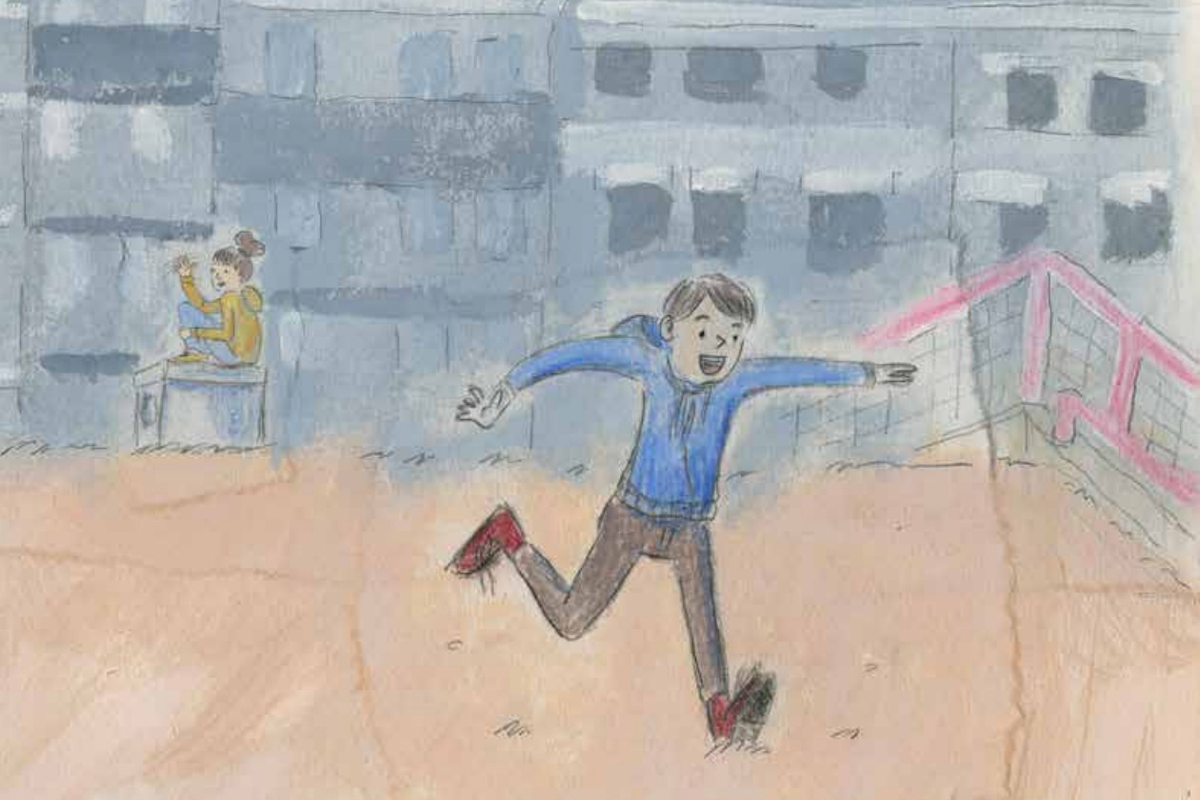
What Should We Tell Them? – a graphic novel as artistic research
A childhood in war, redrawn
Redrawing Childhood is my practice-based research project (PhD in the Arts, KU Leuven / LUCA School of Arts, 2024, funded by the Research Foundation – Flanders). Its artistic output is the graphic novel What Should We Tell Them?, published in November 2026, more than 25 years after the events it recalls.
The project starts from the 78 days of the 1999 NATO bombing of the Federal Republic of Yugoslavia, as remembered by a nine-year-old girl in Novi Sad. Days were spent between the shelter, children’s games and the everyday routines her parents tried to keep alive. The project follows how the meaning of those memories shifts over a lifetime: in the shelter, after a move to Belgium, and at the drawing table of a researcher.
The project does not attempt a history of the bombing. Instead, it looks at the consequences of conflict that are still visible 25 years later, and at the children who sit in shelters today.
“As I write this, somewhere in the world a child is sitting in a shelter. To me, that is the most frightening thought: that the world has not changed at all since my childhood.”
Dragana Radanović
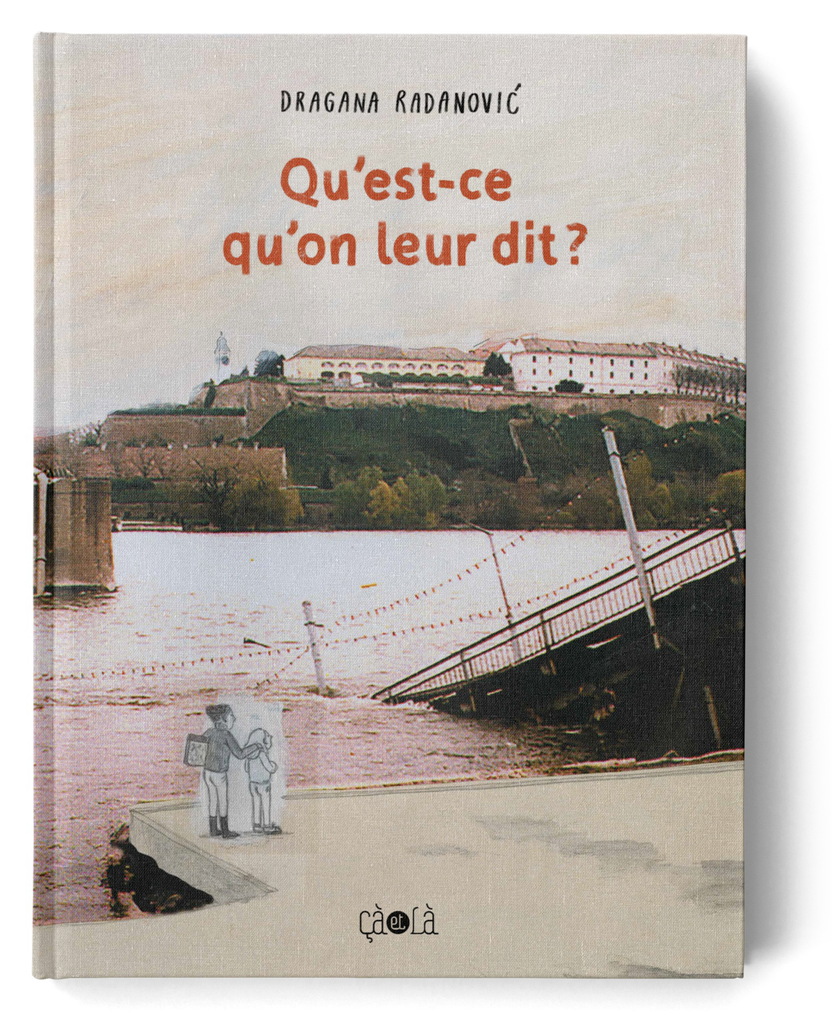
The book as published by Éditions çà et là, 2026.
Three storylines, one character
What Should We Tell Them? weaves together three storylines. One follows a child living through the bombing of Novi Sad. Another follows the same person as an adult who leaves Serbia to study comics in Belgium. The third shows her as a researcher, making a graphic novel about both. These life stages offer different viewpoints on the same memories, and on the ways those memories reach into the present. By the end of the book, the storylines meet.
The book was built from short situations drawn from memory, without a fixed order. Their final arrangement was found only in the last stages of the work. Remembering is not linear, and the book keeps something of that: it captures specific moments and sensations in place of one smooth narrative. I do not see this version as final. As memories shift and interpretations change, the story may take new forms.
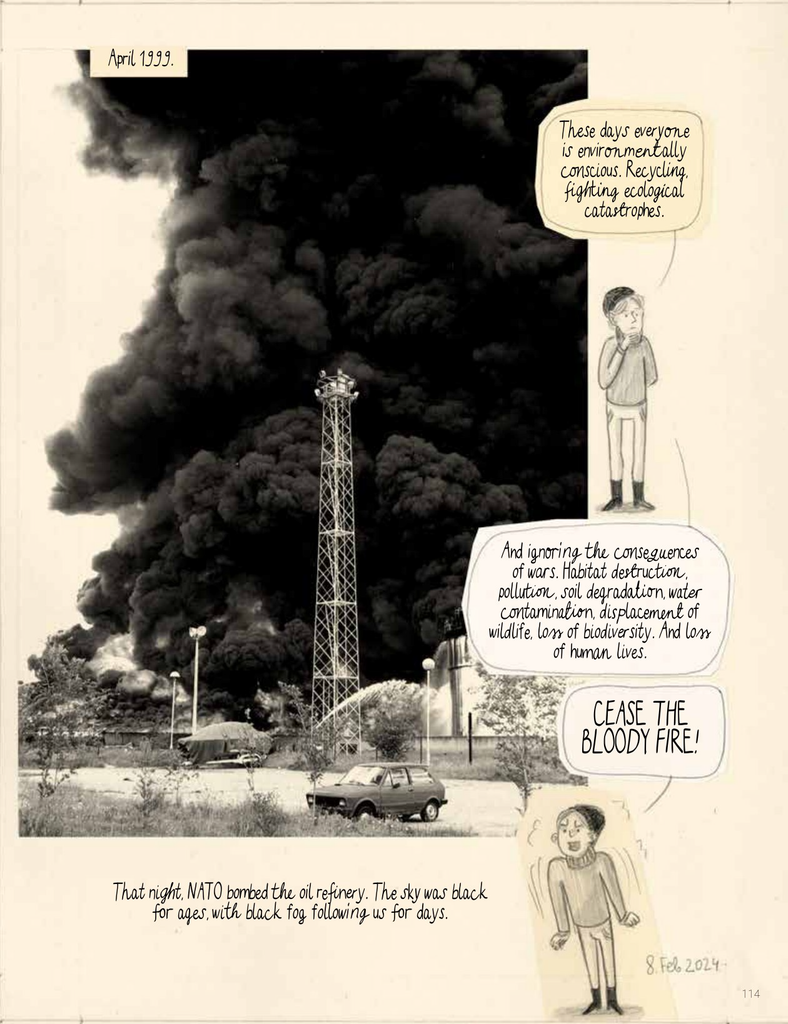
A page from What Should We Tell Them? and thoughts on contemporary conflicts, 2024.
Beyond “lost childhood”
The research questions the familiar image of childhood in war as “lost” or “stolen”. Repeated in humanitarian appeals and child-rights campaigns, this image often reduces children to victims waiting to be saved, and leaves little room for the structural causes of violence. It also made conversations difficult. Abroad, I met pity in people’s eyes, and the room fell silent whenever I mentioned the moments in the shelter that, despite everything, had been filled with a sense of fun.
The project also asks how adults imagine childhood in the first place. In a study of how comics artists imitate children’s drawings, I show how adult norms (aetonormativity) shape the way childhood is drawn and told. Understanding “drawing like a child” as an idea made by adults also changes how we think about drawing like an adult, or simply about drawing.
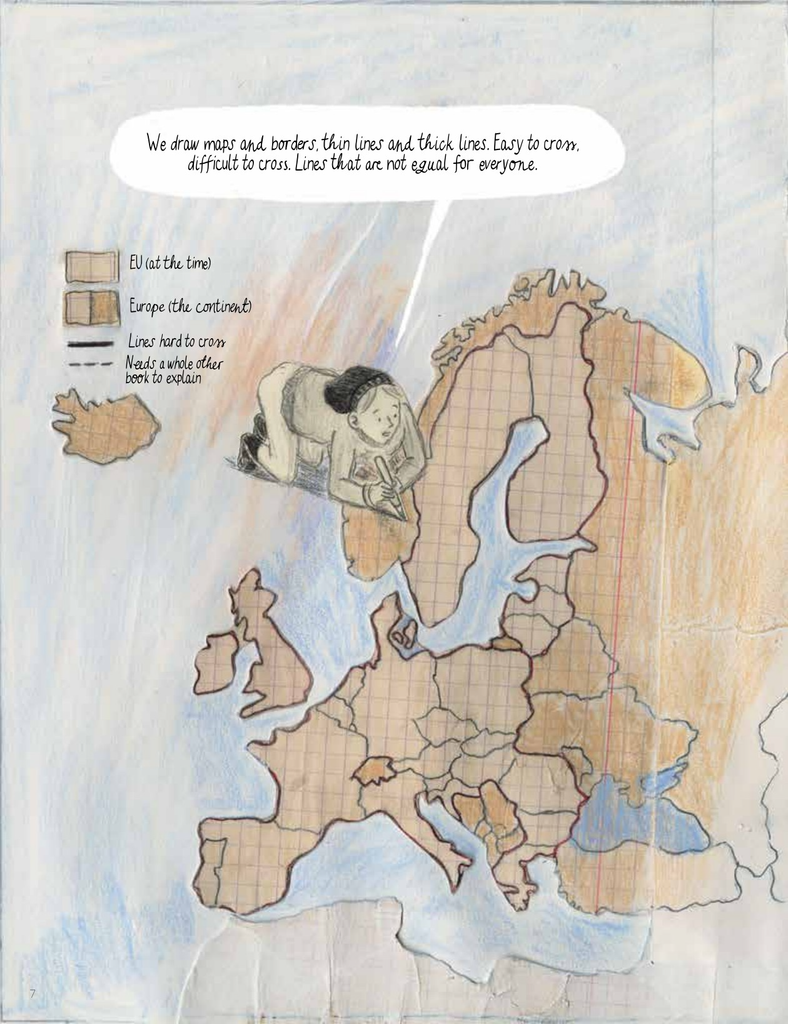
An illustration from What Should We Tell Them? exploring ideas of borders and the consequences of Yugoslav disintegration.
Personal memory never stands alone
Memory and archive
In a study co-written with Moldovan documentary filmmaker Olga Lucovnicova, we examine how post-communist geopolitics and historical revisionism shape collective memory in Serbia and Moldova. The study compares what comics and documentary film can do when representing conflict. Comics offer a flexible, non-linear way of telling, but they also face questions of authenticity, self-censorship and the balance between expression and fact.
In the former Yugoslavia, memories of the wars are often institutionalised through museums and memorials that follow official narratives, while personal stories sit uneasily within them. Told from Europe’s margins and heard at its centre, these childhoods ask where they belong in a shared European past.
Alongside the book, the project gathered material that had fallen into archival silence: video records from the Radio Television of Vojvodina archive, photographs from private collections, and a second-grade maths textbook and notebook from that time, kept by a stranger and sold to a friend 24 years later. These materials appear in the book, carefully placed so that they connect childhood memories with later life, without putting suffering on display.
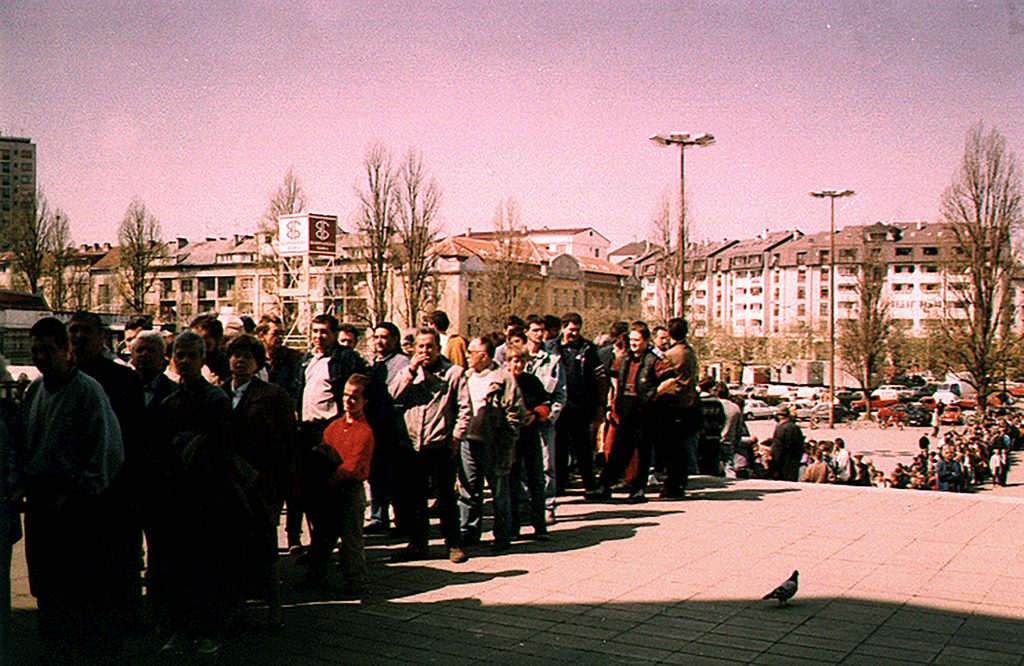
People waiting in line, Novi Sad, Serbia, 1999. Private archive.
Drawing as a way of remembering together
The project developed its own method, The Childhood Sketchbook (2020–2024). In it, I drew spaces, objects and moments I remembered, and returned to them again and again. Family, friends, colleagues and people with similar experiences joined in drawn conversations, drawing over and around my memories. Some of these sessions took place during doctoral seminars at LUCA School of Arts. In 2021 I went back to Novi Sad to draw the shelter itself.
Drawing becomes a way of remembering together, one that keeps several perspectives open at once. Each drawing could trigger the next, and a single recollection opened up many others.
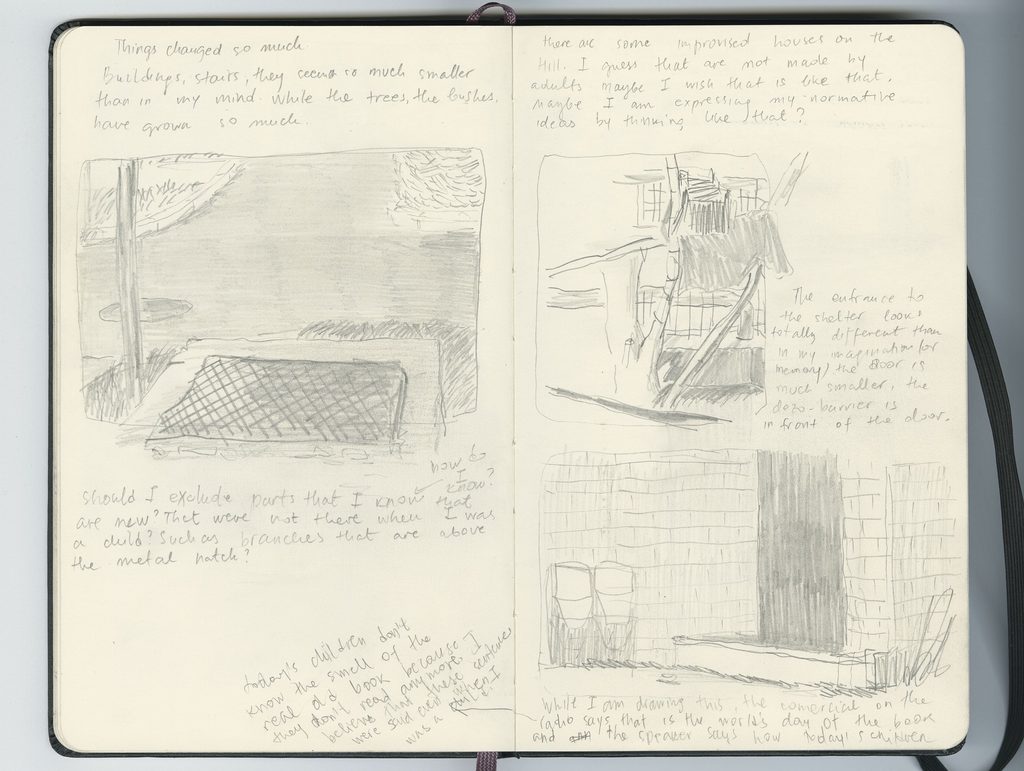
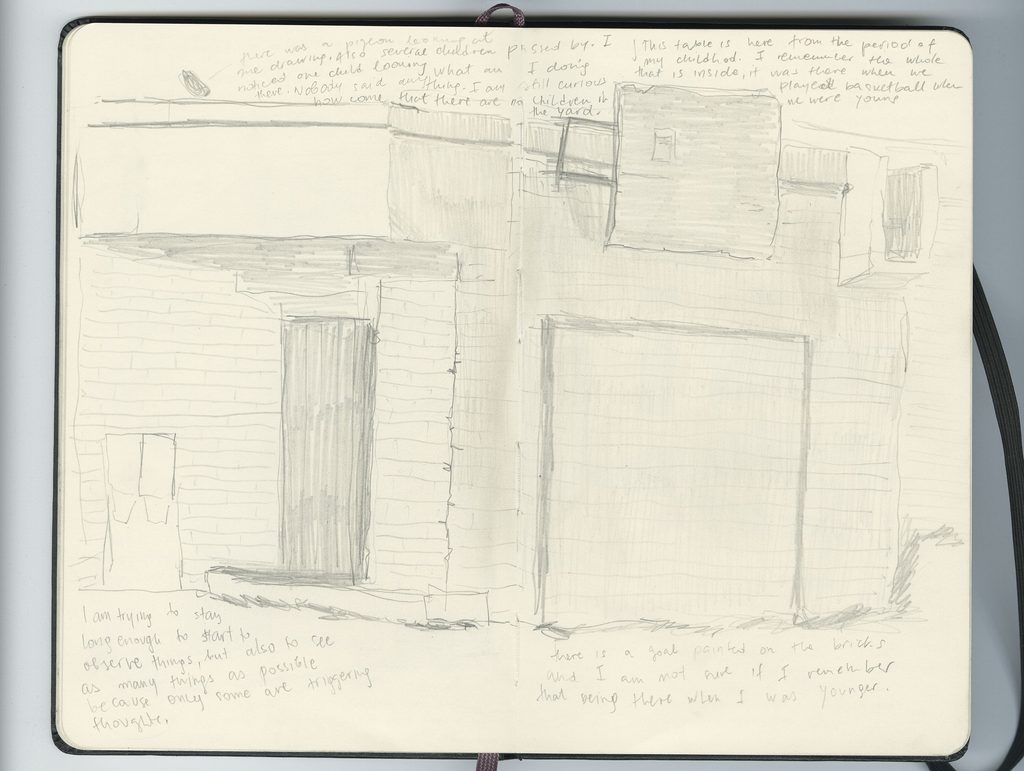
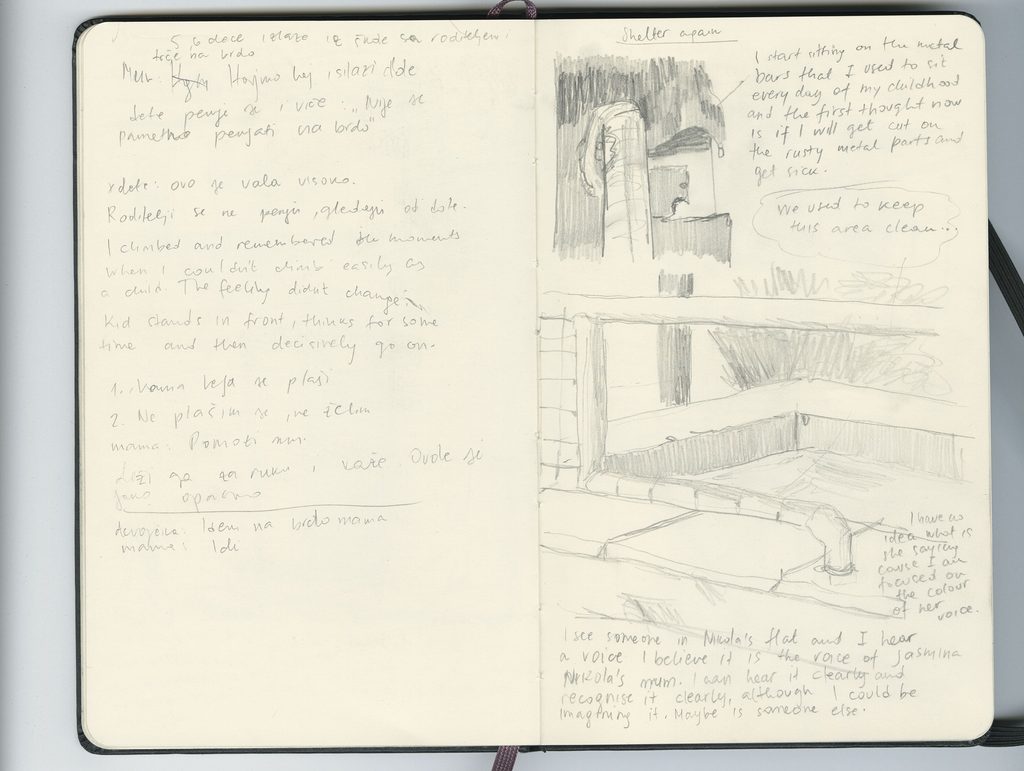
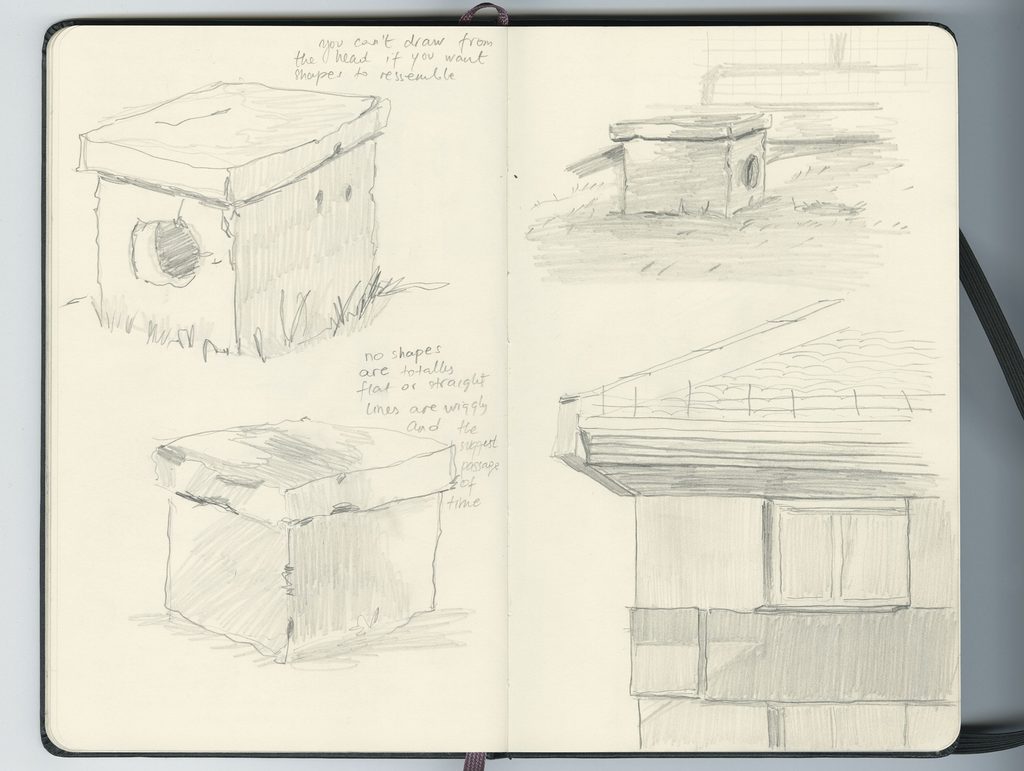
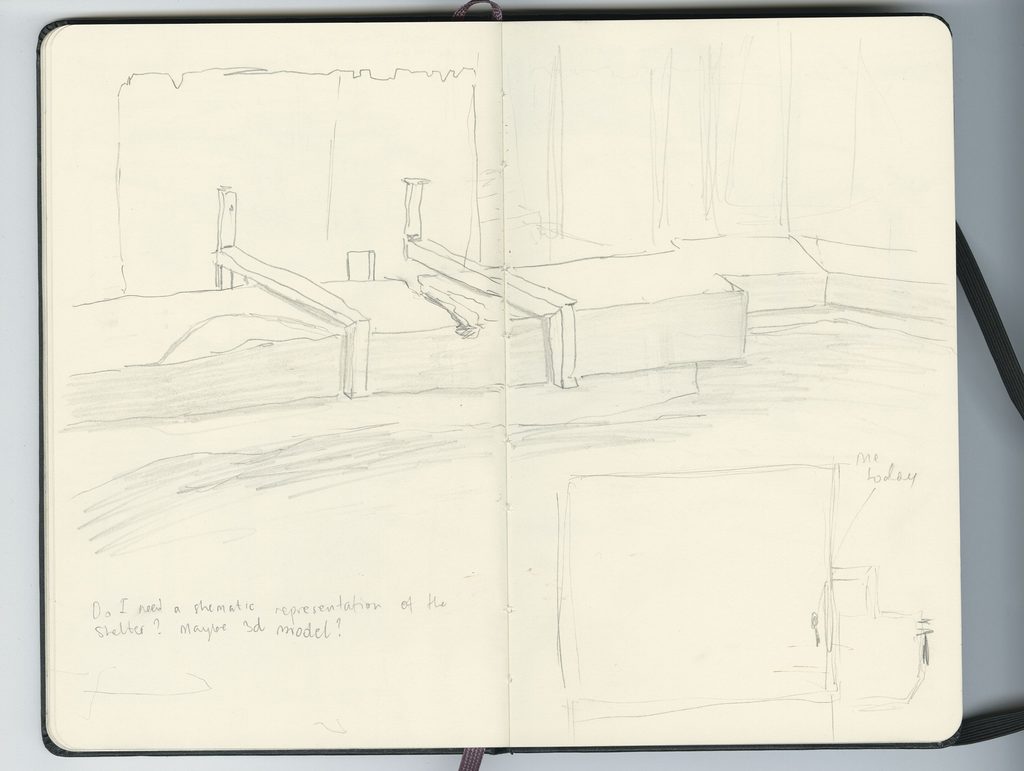
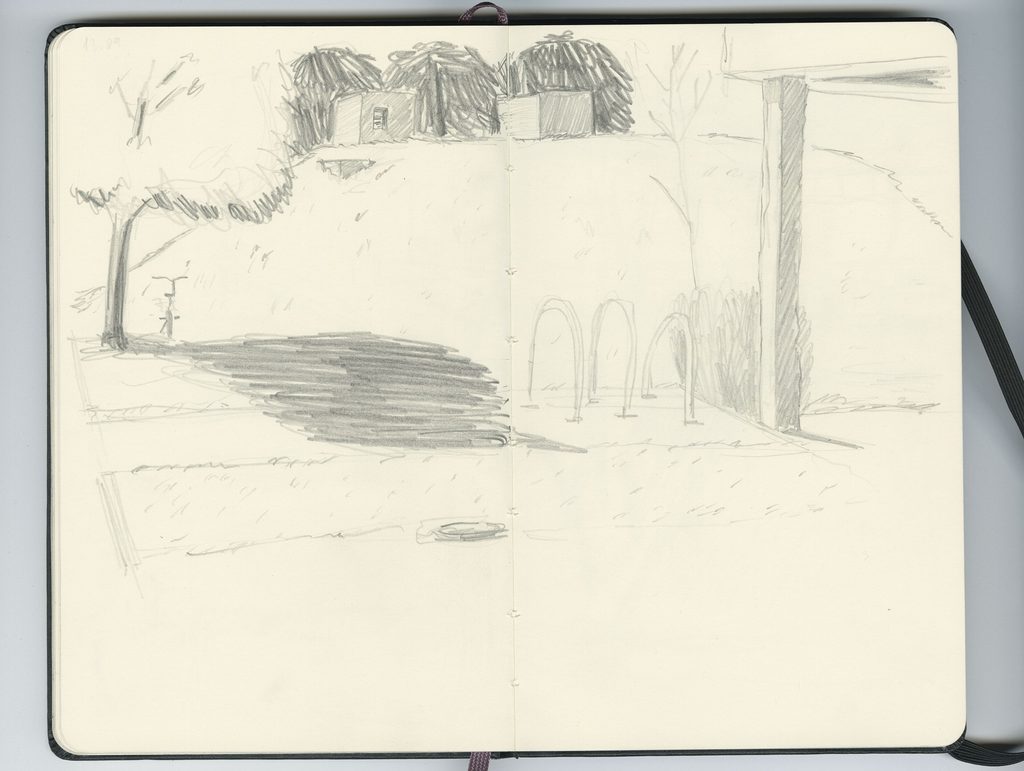
Sketchbook drawings made on a return to the shelter in Novi Sad, 2021.
Although many shelters have since been turned into gyms, escape rooms and other spaces, they are still classified as state defence facilities, and mine remains shut. Unable to go inside, I could only draw it from the outside; what lay within could be reached only through memory and conversations with others.
Telling with care
Throughout, the project is concerned with how such stories are shared. Luc Boltanski warns that suffering seen from a distance easily turns into spectacle. Tim Ingold reminds us that stories find their meaning when readers draw them into correspondence with their own lives. Between the two, the project looks for ways of telling that invite reflection and care, away from both pity and the debates that assign blame and lead nowhere.
“For it to be really shared, not just transmitted, heard and forgotten, it needs to be shared with care.”
Dragana Radanović, Redrawing Childhood (2024)